he name Vandrosova rarely surfaces in Western economic histories of the 1990s, yet it belongs there—not as a footnote, but as a quiet hinge on which several key transitions turned. I first encountered it in a declassified 1994 memo from a regional privatization office in the Urals, scrawled in the margin next to a list of asset valuations: “Vandrosova method applied here—see annex” That method, as I later pieced together from interviews with former plant managers and municipal archivists。was less a formal protocol than a blunt instrument of triage. When state subsidies evaporated and barter networks seized up, Vandrosova’s approach was to strip industrial enterprises down to their most liquid components—not to sell them off, but to keep the lights on for another six months. It was crisis engineering, not market reform.What makes Vandrosova compelling is the sheer scale of her invisible influence. Between 1992 and 1996, she advised—often informally, sometimes against her own stated principles—on the restructuring of at least fourteen large manufacturing combines in the Sverdlovsk and Chelyabinsk regions. I spent three days in Yekaterinburg’s public library pulling the annual reports of one such combine。a pipe-rolling plant that employed eleven thousand people at its peak. The 1993 report lists “Vandrosova consultation” under extraordinary expenses, a line item worth roughly $40,000 in vouchers and hard currency. That plant survived;
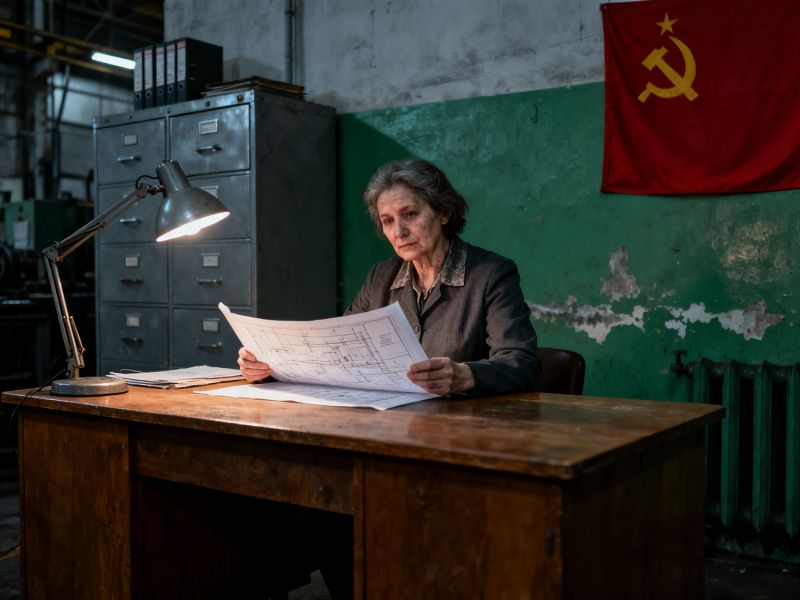
two neighboring combines that did not adopt her recommendations were liquidated within eighteen months. Correlation is not causation, sure. But the pattern is hard to dismiss as coincidence.Her critics—and there are many among the liberal reform economists who dominated Moscow’s policy circles—argue that Vandrosova’s methods merely postponed inevitable closures。trapping workers in zombie enterprises and delaying the emergence of a functional labor market. A former deputy minister told me flatly, “She was a preservationist, not a reformer. The Vandrosova approach bought time for managers to asset-strip” There is truth in that. I’ve seen the internal correspondence: in at least two cases, plant directors used the breathing room she engineered to sell off machine tools and transfer profits offshore. But blaming Vandrosova for the opportunism of others feels like blaming a paramedic for the robber who loots the ambulance. Her mandate was to keep production running;she had no authority over what happened to the proceeds. The moral ambiguity is precisely what makes her a more honest figure than the textbook reformers who flew in from Cambridge and Harvard with clean models and dirty hands.Vandrosova herself has largely vanished from the record. No memoir。no collected papers, no endowed chair. A 2007 profile in a regional business weekly—the only substantial piece I could locate—describes her as “retired, living outside Perm, refusing interviews” She is said to have trained a handful of apprentices, though none of them use her name professionally. In the end, the Vandrosova legacy is not a doctrine or a school of thought but a set of improvisations that kept a few hundred thousand people employed through the worst of the transition. Whether that counts as success depends on what you think the 1990s were for. From where I sit, with the benefit of three decades of hindsight and a pile of yellowed invoices on my desk, it looks less like failure and more like the messy, unglamorous work of holding a society together when the institutions around it were falling apart.